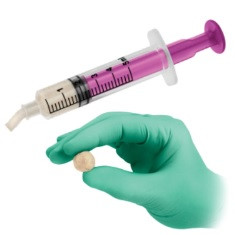
- A 0.7cc demineralized bone matrix (DBM) allograft in a flowable syringe, used primarily in dental and oral surgical procedures to promote bone regeneration
Uses
- Socket Preservation:
- Placed in extraction sites to maintain ridge volume
- Ridge Augmentation:
- Used to increase the width or height of the alveolar ridge
- Sinus Lift Procedures:
- Fills the floor of the maxillary sinus to prepare for implants
- Periodontal Defects:
- Treats bone loss around teeth caused by gum disease
- Cystic Voids:
- Fills spaces left after the removal of cysts or benign bone tumors
Features
- 100% Human Bone Tissue:
- Contains no extrinsic carriers or fillers (like glycerol or CMC), ensuring the graft's potency isn't diluted
- Flowable Consistency:
- Packaged in a pre-filled 0.7cc syringe (VF25070) for easy dispensing and adaptability to irregular voids
- Dual Biological Action:
- Combines osteoinductive properties (contains growth factors like BMPs to trigger cell differentiation) with an osteoconductive scaffold (supports new bone growth)
- Ready-to-Use:
- Requires no reconstitution or preparation time and can be stored at ambient room temperature
- Sterile Processing:
- Gamma irradiated to a Sterility Assurance Level (SAL) of 10⁻⁶ following FDA and AATB guidelines
Benefits
- Superior Handling:
- The putty is resistant to washing away or migrating during irrigation (lavage), which keeps the graft stable at the surgical site
- High Biocompatibility:
- Because it is entirely derived from human bone, it minimizes the risk of foreign body reactions often associated with synthetic carriers
- Accelerated Healing:
- The high concentration of natural bone morphogenetic proteins (BMPs) can lead to faster tissue regeneration compared to mineralized materials
- Efficient Delivery:
- The syringe allows for direct application, potentially reducing surgical "chair time" and simplifying the procedure for the clinician