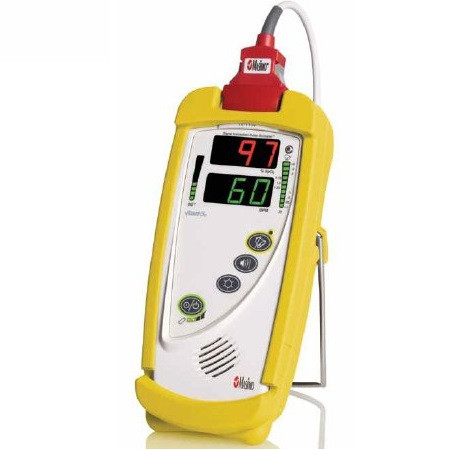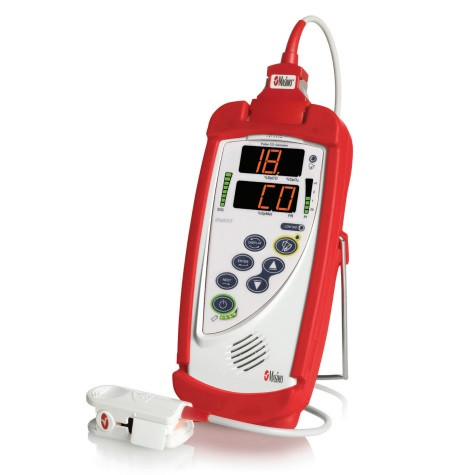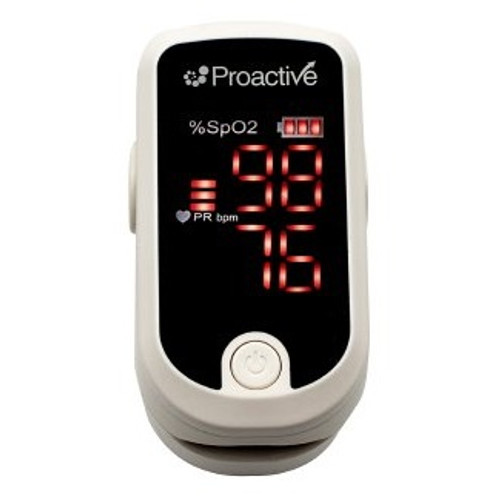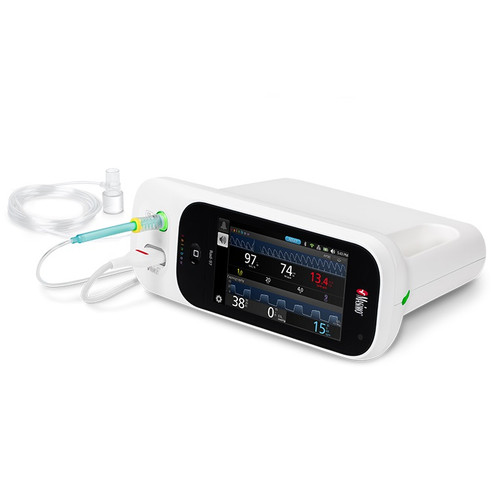

- A comprehensive, portable patient monitoring solution built around the Rad-97 Pulse CO-Oximeter, designed to provide continuous, noninvasive, and accurate monitoring of vital signs
- It is frequently used in hospitals (general wards, ICU, emergency departments) and, due to its portable design, in pre-hospital, long-term, and home settings
Uses
- Continuous Monitoring:
- Offers real-time, noninvasive monitoring of oxygen saturation (SpO2), pulse rate (PR), and perfusion index (Pi)
- Capnography (EtCO2):
- Built-in gas analyzer for monitoring end-tidal CO
 2in both intubated and non-intubated patients, critical for confirming airway placement
- Advanced Parameter Assessment:
- Capable of measuring Total Hemoglobin (SpHb), Carboxyhemoglobin (SpCO), and Methemoglobin (
 SpMet)
- Patient Transport & Spot-Checking:
- The device is portable and can be mounted on a roll stand, making it suitable for transporting patients or quick, in-round spot-checks
- Remote Monitoring:
- Integrates with systems like Patient SafetyNet, enabling central monitoring of up to 200 patients
Features
- Masimo SET® Technology:
- Utilizes Signal Extraction Technology for accurate readings during motion and low perfusion
- Integrated Capnography (NomoLine):
- Features NomoLine sidestream capnography, which requires minimal maintenance and no routine calibration
- High-Resolution Display:
- Bright, color-coded, touch-screen interface
- Versatile Power & Mounting:
- Operates via a rechargeable Li-ion battery (approx. 4 hours of life) and can be mounted on a wall or stand
- Comprehensive Sensors:
- Kit includes reusable adult and pediatric/infant sensors
- Data Connectivity:
- Supports Bluetooth, Wi-Fi, and Ethernet for seamless data transfer to Electronic Medical Records (EMRs)
Benefits
- Improved Accuracy:
- Provides accurate measurements on all skin tones and during challenging conditions
- Reduced False Alarms:
- Features a >80% reduction in false alarms compared to traditional technology, reducing "alarm fatigue" for clinicians
- Enhanced Safety:
- Enables earlier identification of patient distress, potentially reducing rapid response team activations and ICU transfers
- Efficient Workflow:
- Allows for automated data entry into EMRs, saving time and reducing manual transcription errors
- Cost Savings:
- The system is designed to reduce the need for more frequent, expensive blood tests through continuous, noninvasive monitoring
- Versatility:
- Suitable for diverse, long-term monitoring scenarios (from neonatal to geriatric patients)