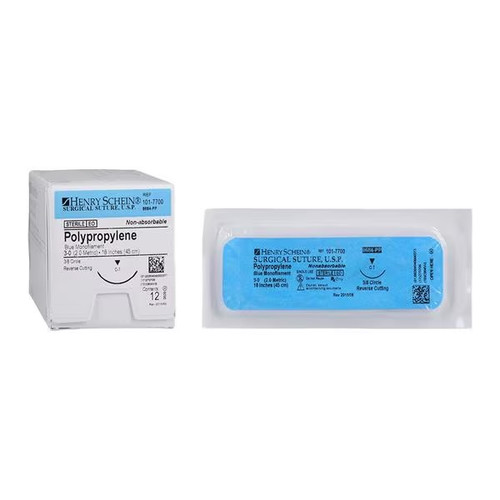
- Non-absorbable suture used for soft tissue closure in various medical and dental surgical procedures
Uses
- Soft tissue closure:
- Used for reliable and effective closure in a wide range of oral surgery, general surgery, and skin closure procedures
- Periodontal and implant surgery:
- Its smooth, monofilament surface and non-absorbable nature make it suitable for a variety of surgical procedures, especially where minimal tissue drag is desired
- Microsurgery:
- The fine size (5-0) and precise needle are ideal for delicate microsurgical applications
- Cardiovascular and plastic surgery:
- It is also commonly used in other specialties like plastic surgery, neurosurgery, ophthalmology, and cardiovascular surgery
Features
- Material:
- Made from polypropylene, a synthetic, non-absorbable, monofilament material known for its high tensile strength and inertness
- Smooth surface:
- The smooth, monofilament structure provides minimal tissue drag, allowing for smooth passage through tissue and easy knot placement and removal
- Minimal tissue reaction:
- The material is biologically inert, resulting in minimal tissue irritation and inflammation
- Blue color:
- The blue color offers good visibility in the surgical field
- Superior needle:
- Features a high-quality C-3 needle (3/8 circle, reverse cut) that is honed to a unique multi-edged point for greater ease of penetration
- Superior attachment:
- The needles are laser-drilled for a seamless needle-suture juncture, providing a smoother transition with less tissue disruption
- Minimal memory:
- The suture has little package memory, making it easy to handle and tie securely
Benefits
- Smooth Tissue Passage:
- The uniformly round cross-section allows the strand to pass through delicate tissue with minimal drag
- Enhanced Knot Security:
- Designed to knot securely with fewer throws compared to other monofilaments
- Greater Ease of Penetration:
- Needles are honed to a unique multi-edged point for sharper, more precise entry
- Infection Resistance:
- As a synthetic monofilament, it is resistant to bacterial colonization and does not harbor microorganisms